
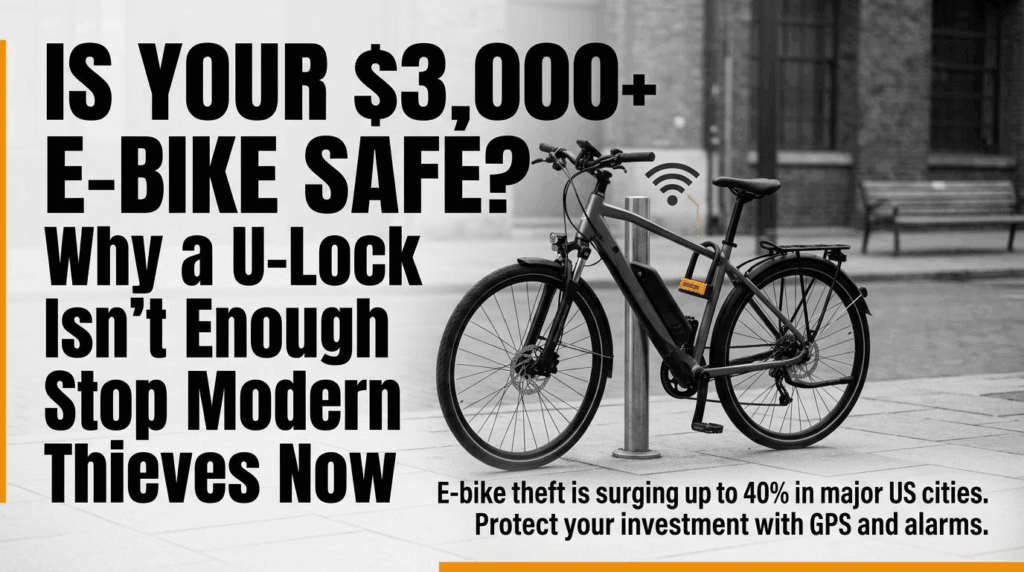
The E-Bike Boom Has a Theft Problem
Electric bikes have gone from niche commuter gadget to mainstream American transportation. In 2025 alone, roughly 1.5 million e-bikes were sold in the United States, pushing the US market value to over $1.1 billion (IMARC Group). They’re on bike paths, in apartment lobbies, locked to city racks, and parked outside coffee shops from Portland to Miami.
Thieves have noticed.
According to the Bike Index 2025 Annual Bike Theft Report — compiled from a registry of over 1.3 million registered bikes in partnership with UC Santa Barbara and UC Davis — an estimated 2.4 million bicycles are stolen every year in the US, representing $1.4 billion in losses. In 2024, reported stolen bikes in the Bike Index registry jumped 15% year-over-year. For e-bikes specifically, theft reports climbed even faster: 25–40% year-over-year in major cities including Portland, Seattle, Los Angeles, and Denver, according to data from the National Insurance Crime Bureau (NICB) and Bike Index.
Simply put, the more valuable your bike, the more attractive it is to steal. And e-bikes are consistently the most valuable bikes parked on any given street.
Why Thieves Target E-Bikes
High value, easy to resell
Quality e-bikes range from $1,500 to $6,000, with the volume-weighted average in the US sitting around $1,380 (Statista 2025). Mid-range models from brands like Trek, Specialized, and Rad Power land squarely in the $2,000–$4,000 bracket. That kind of street value makes an e-bike more profitable to steal than most portable electronics.
Unlike a laptop, which requires wiping and reselling on niche forums, a desirable e-bike can move quickly on Craigslist, Facebook Marketplace, or through informal channels. Organized theft rings in cities like NYC, San Francisco, and Chicago have been documented purchasing stolen e-bikes in bulk and reselling them across state lines.
The battery is worth stealing on its own
Even when a thief can’t take the whole bike, the battery is a high-value target. Quality lithium e-bike batteries command $300–$800 on the secondary market. A theft that takes three minutes to cut through a cable lock can yield a component worth more than many traditional bicycles. Some thieves don’t even bother with the frame — they strip the battery, the motor, and any quick-release components and leave the rest behind.
Weight actually helps thieves
Counter-intuitively, the 40–80 lb weight of most e-bikes works in a thief’s favor. Because carrying the bike is difficult, thieves prefer to cut the lock and roll the bike away — which means a quality U-lock through only the rear wheel often isn’t enough. Unless both wheels and the frame are secured to an immovable anchor, a motivated thief can simply lift and wheel your bike out.
Where E-Bikes Get Stolen — the Numbers May Surprise You
At home (59% of all bike thefts)
The most striking finding from the 2025 Bike Index report: 59% of bike thefts occur in residential areas. That’s in driveways, apartment parking garages, building lobbies, backyard sheds, and patios. Many cyclists invest in a heavy lock for public use but leave their bike casually leaned against a wall at home — and that’s exactly where the majority of thefts happen.
Ground-floor apartment storage, communal bike rooms with flimsy door locks, and garages with no alarm are all prime targets. Thieves know that residential theft involves less exposure than working on a busy street.
The 15-minute opportunity stop
The second most common window is the brief public stop: a coffee shop run, a grocery pickup, a quick lunch. Experienced thieves scout locations where high-value bikes appear regularly. A bike locked for under an hour at the same café every weekday becomes a predictable, low-risk target. Lock-cutting on a busy sidewalk takes under 60 seconds with the right tools and barely draws attention.
Top theft hotspot cities according to 2025 data: New York City, San Francisco, Chicago, Los Angeles, Seattle, Portland, Denver, Austin, and Minneapolis.
Charging stations and trailheads
As e-bike infrastructure expands, so do the theft opportunities. Public charging stations — now appearing at transit hubs, parks, and shopping centers — create predictable clusters of high-value bikes left unattended for 30–90 minutes. Trailhead parking lots present a similar scenario: bikes left on racks or in vehicles while riders are on the trail, sometimes for hours at a stretch.
Why a U-Lock Alone Isn’t Enough
Physical locks remain the first line of defense, and a quality U-lock is far better than a cable. But they have hard limits:
Lock cutting is the dominant method. Data from the Bike Index shows that 59% of stolen bikes were locked at the time of theft. Bolt cutters, angle grinders, and hydraulic cutters defeat most consumer-grade locks quickly and quietly.
A lock can’t tell you when something’s wrong. If your bike is tampered with at 2am in your apartment building’s garage, you won’t know until morning — long after the trail has gone cold.
Recovery rates are dismal without tracking. The FBI reported 127,646 bicycle thefts in 2023, but research estimates only 37% of victims report to police at all. Among those reported, recovery rates are extremely low — under 5% without a registered serial number or GPS tracker. Once a bike leaves the scene, the chances of getting it back without real-time location data are slim.
What a U-lock can’t do — alert you the moment something moves, and tell you exactly where your bike is — is where technology picks up the slack.
How AlterLock Gen3 Works for E-Bike Owners
AlterLock Gen3 is a compact anti-theft device (167mm × 28mm × 9mm, 53g) designed to mount directly to a bike frame. It’s light enough that it doesn’t interfere with the riding experience, and at IP66-rated waterproofing, it holds up through rain, mud, and bike washes.
Here’s what it does that a lock can’t:
Motion detection and 95dB alarm. The moment someone touches your bike, the onboard sensor triggers a loud alarm — up to 95dB at close range. That’s equivalent to a motorcycle engine at close distance, enough to startle a thief and alert anyone nearby. Sensitivity is adjustable so that passing traffic doesn’t set it off.
GPS location. AlterLock Gen3 uses a combination of GNSS (GPS + Galileo), Wi-Fi positioning, and LTE-M cellular to report your bike’s location to the companion app on your phone. If your bike moves, you get a push notification immediately. If it keeps moving, you have a GPS history data to hand to police.
LTE-M connectivity — no Wi-Fi required. Unlike trackers that rely on Bluetooth proximity or need a home network to sync, AlterLock Gen3 communicates over LTE-M cellular. This means it works whether your bike is parked on a city street, inside a parking garage, or outside a suburban coffee shop. Coverage extends across the continental United States. *(some restrictions may apply)
Auto-lock and auto-unlock. The device senses your phone’s proximity via Bluetooth and automatically arms when you walk away, disarms when you return. No fumbling with buttons mid-commute.
Up to 3 months battery life. A single charge lasts up to three months under typical use, so you’re not constantly managing yet another battery.
For e-bike owners specifically, AlterLock addresses the two most common theft scenarios: the residential overnight theft (you’ll get an alert if the bike moves in your garage) and the public opportunity theft (the alarm goes off before the thief even cuts the lock).
A Practical Security Checklist for E-Bike Owners
No single measure is foolproof, but layering security significantly raises the effort threshold for a thief:
- Use a hardened U-lock through the frame and rear wheel, secured to a fixed object. Avoid cable locks as a primary lock — they’re defeated in seconds.
- Add a second lock on the front wheel using a different lock type (e.g., folding lock or chain). Two different lock types require two different tools.
- Remove the battery when leaving the bike unattended for extended periods. This also eliminates the battery-only theft scenario.
- Mount an AlterLock Gen3 so that any movement triggers an immediate alarm and GPS alert to your phone.
- Register your serial number with Bike Index (free). This dramatically improves recovery odds if the bike is found.
- Store at home out of sight. Ground-floor windows and open garages are invitations. If your building has a bike room, use the most secure anchor point available and still lock up.
- Park in high-visibility, high-traffic locations in public. Thieves prefer low-foot-traffic spots where they can work undisturbed.
Bottom Line
The US e-bike market isn’t slowing down — and neither is e-bike theft. A 25–40% year-over-year surge in reported thefts in major cities means that every year you own a quality e-bike without a layered security strategy is a year you’re running an avoidable risk.
A U-lock is table stakes, not a complete solution. Pairing physical locks with a real-time alarm and GPS tracker like AlterLock Gen3 closes the gap that no lock alone can cover: knowing the moment something’s wrong and having location data to act on.
Disclaimer: AlterLock is a device that supports theft deterrence and early detection. It does not guarantee prevention of theft. Always use physical locks in combination with AlterLock for best results.
Published: June 18, 2026 | Category: Anti-theft topics