
The Problem Nobody Talks About Before the Ride
You’ve driven 45 minutes to your favorite trailhead. You unload your bike, clip in, and disappear into the woods for a few hours. It’s one of the best parts of living in the American West — or the Southeast, or the mid-Atlantic, or wherever your local trails happen to be.
When you come back, your bike is gone.
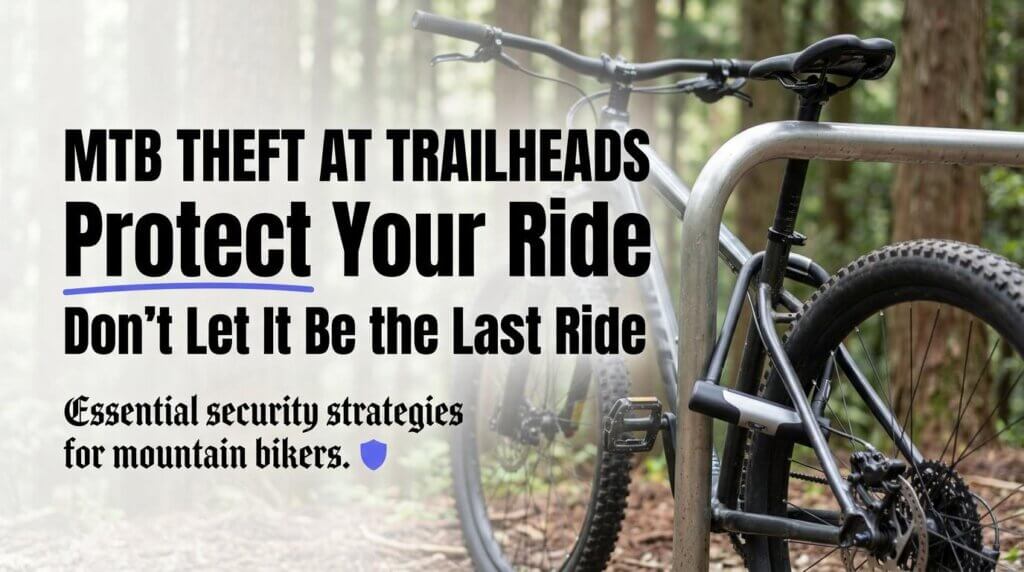
Trailhead bike theft is one of the most underreported and under-discussed security problems in the cycling community. Unlike urban theft — which happens fast, in front of witnesses, on a busy street — trailhead theft unfolds in the opposite conditions: isolated parking areas, no surveillance cameras, long unattended windows, and riders who return to find their bike missing hours after the fact. By then, there’s almost nothing law enforcement can do.
This piece looks at how trailhead theft actually happens, why the standard advice often falls short, and what a layered security strategy looks like for riders who spend time on the trail.
The Scale of the Problem
The national picture
An estimated 2.4 million bicycles are stolen every year in the United States, according to the Bike Index 2025 Annual Bike Theft Report — compiled from a registry of over 1.3 million registered bikes. The total value of those stolen bikes exceeds $1.4 billion annually. Reported thefts rose 15% in 2024 alone.
Mountain bikes represent a significant share of that total. Hybrid, city, and mountain bike styles together account for 31% of all stolen bikes nationwide — and mountain bikes skew toward the high end of the value range. In states with strong trail culture, average stolen bike values are among the highest in the country.
Colorado: the mountain bike theft capital
No state illustrates the problem better than Colorado. According to data analyzed from FBI crime reports and Bike Index registry data:
- Colorado leads the nation at 124.8 bicycle thefts per 100,000 residents — more than four times Florida’s rate and over twice California’s (Sundays Insurance)
- The average value of a stolen bike in Colorado is $1,936.92 — the highest in the United States
- Denver alone averaged 105.2 bicycle thefts per month in 2024, up from 91.2 per month in 2023
That elevated average value reflects Colorado’s mountain bike culture. When a $4,000 full-suspension rig goes missing at a trailhead, the monetary loss is significant — but so is the loss of a sport you’ve built your schedule around.
Trailhead break-ins doubled in two years
The surge in trailhead-specific theft is documented. One researcher tracking data across more than 30 police departments found that trailhead break-ins increased 100% from 2020 to 2021 — and that trend has continued as outdoor recreation participation grew post-pandemic (WifiBum).
In Washington state, the Forest Service’s Baker-Snoqualmie National Forest unit has acknowledged the problem directly, with an official stating: “The problem is there are more people breaking into cars than we have folks to enforce it.” Law enforcement resources in remote trailhead areas are limited by design — these are forests, not urban precincts.
Meanwhile, Portland, Seattle, Denver, and Austin are all reporting 8–12% year-over-year increases in bike theft reports, with trailhead-adjacent areas among the growth zones (Bike Index 2025).
How Trailhead Theft Actually Happens
Understanding the mechanics of trailhead theft matters because the scenarios are different from urban theft — and the countermeasures need to match.
Smash-and-grab from vehicles
The most common scenario isn’t the bike itself — it’s everything in the car or truck while the rider is on the trail. Bike shoes, helmets, hydration packs, car keys, wallets, and gear bags are all left behind. Thieves patrol trailhead lots, identify vehicles with expensive gear visible, and break windows in seconds.
This matters for bike security because: if your spare key is in the glove box, the thief now has access to the bike rack. If your lock combination is written on a note in the center console, you’ve handed over the combination. Physical security of the vehicle is the first line of defense.
Bikes taken directly from racks or trees
Bikes locked to vehicle-mounted racks, trees, fence posts, or trailhead kiosks are a direct target. Trailhead locks typically face lower scrutiny than urban locks: there are fewer passersby, no shop owners with a vested interest in the block, and often no cameras. A thief can spend several minutes working on a lock with power tools in a remote parking area without anyone noticing.
The window of vulnerability is also much larger at a trailhead than at a coffee shop. A 30-minute urban errand becomes a 2–4 hour ride in the woods. Thieves know this and time their operations accordingly.
Bikes left trailside during the ride
Less common but documented: bikes left at a junction or at the bottom of a climb while a rider does a second lap on foot or scouts a section. Any bike left unattended trailside for more than a few minutes is a theft opportunity in high-traffic recreation corridors.
Why Standard Advice Falls Short at Trailheads
Trail riders get the same advice as urban cyclists: “use a good lock, lock to something solid.” That advice is correct but incomplete when applied to trailhead conditions.
Trailheads often lack fixed anchor points. Most trailhead parking lots have no dedicated bike parking infrastructure. Riders end up locking to vehicle racks, tree trunks, or fence posts — none of which provide the security of a ground anchor or steel pole embedded in concrete.
There’s no social deterrent. In cities, would-be thieves are deterred partly by the presence of other people. Busy storefronts, security cameras, and foot traffic create friction. A remote trailhead at 9am on a Tuesday has almost none of that.
The time window is long enough to defeat most physical locks. A capable thief with the right tools can defeat most consumer-grade U-locks in under three minutes. At a trailhead where a bike might be unattended for three hours, that math heavily favors the thief.
You won’t know it’s happening. In an urban setting, a nearby alarm or a passerby’s shout might interrupt a theft in progress. At a trailhead, the first you’ll know is when you come back.
What a Layered Security Strategy Looks Like
No single measure stops a determined thief in a remote location. But each additional layer increases the time, effort, and risk required — and most thieves are opportunists, not professionals.
Layer 1: A hardened physical lock
Use a quality U-lock or a hardened chain lock rated at a high security level (Sold Secure Gold or equivalent). Lock the frame and rear wheel together through a fixed object. If nothing solid is available, run the lock through a ground anchor on your vehicle-mounted rack that’s bolted to the hitch receiver.
A cable lock as a primary lock at a trailhead is essentially no deterrent at all against someone with bolt cutters.
Layer 2: A second lock on a different part of the bike
Add a secondary folding lock or chain through the front wheel and a different anchor point. Two locks require two different tools and double the time on-site — both of which deter opportunistic thieves.
Layer 3: A GPS alarm device
This is where trailhead security diverges most sharply from standard urban advice. In a remote environment with no cameras and no bystanders, a motion-triggered alarm and a GPS tracker is the layer that closes the gap.
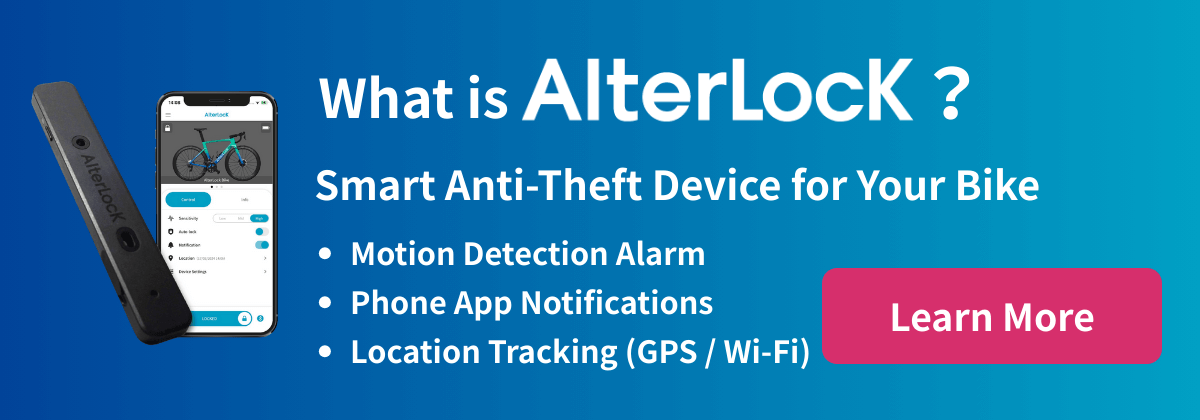
AlterLock Gen3 is a compact device (167mm × 28mm × 9mm, 53g) that mounts to the bike frame. When the bike is moved, it triggers an alarm of up to 95dB — equivalent to a motorcycle engine at close range — and simultaneously sends a push notification to your smartphone. If the bike continues moving, the device reports its location via a combination of GNSS (GPS + Galileo), Wi-Fi positioning, and LTE-M cellular.
The LTE-M connection is especially relevant for trailhead use. Unlike Bluetooth-dependent trackers (AirTag, Tile), which require another user’s device nearby to relay location, LTE-M connects directly to cellular networks. Coverage extends across the continental United States, including many semi-rural recreation corridors where Bluetooth relay density is low.
At IP66 water resistance, the device handles mud, rain, and the general abuse of trail use without issue. Battery life runs up to three months on a charge.
In a trailhead scenario, this means: if someone touches your bike while you’re 90 minutes into the trail, your phone alerts you immediately. You have a location pin. You can call it in before the bike has left the county.
Layer 4: Registration
Register your bike’s serial number with Bike Index (free, used by police departments nationwide). AlterLock has an existing partnership with Bike Index for US cyclists. If your bike is found or recovered, a registered serial number is the difference between it being returned to you and sitting in an evidence room indefinitely.
Practical Trailhead Security Tips
Beyond the layered lock strategy, a few habits reduce exposure significantly:
- Scout before you park. Check for broken glass in the lot, look for signs of recent break-ins, ask locals or rangers about the trailhead’s security reputation. Some lots are chronic targets; others rarely see issues.
- Empty the vehicle before you leave it. Don’t leave shoes, bags, jackets, or anything visible in the car. Take your wallet and phone on the ride. Remove the incentive for window-smashing.
- Choose high-visibility parking. Park near trailhead kiosks, bathrooms, or the main trail entrance — anywhere with more foot traffic and visibility than the far end of an empty lot.
- Vary your timing. Thieves who work trailheads often know the patterns of regular users. Varying your start time reduces the predictability of when your bike will be unattended.
- Take a photo with serial number visible before each ride and store it in the cloud. If your bike is stolen, having that information immediately makes a police report far more actionable.
Bottom Line
Trailhead theft has doubled in recent years, and unlike urban bike theft, it happens in conditions that are almost entirely favorable to the thief: isolation, no cameras, long unattended windows, and high-value targets.
Physical locks remain essential but are not sufficient on their own in remote environments. Adding a GPS alarm device like AlterLock Gen3 closes the specific gaps that trailhead conditions create — the lack of social deterrence, the absence of surveillance, and the long window between theft and discovery. Getting an alert on your phone while you’re still on the trail, with a location pin you can hand to a ranger or sheriff’s deputy, is a fundamentally different situation than returning to an empty bike rack three hours later.
Ride hard — and make sure your bike is going home with you at end of the day.
Disclaimer: AlterLock is a device that supports theft deterrence and early detection. It does not guarantee prevention of theft. Always use physical locks in combination with AlterLock for best results.
Published: June 18, 2026 | Category: Anti-theft topics