
If you’re thinking about getting an AlterLock Gen3 for a bike you ride well beyond city streets — into the hills, along canal towpaths, or out to more remote trailheads — there’s a fair question worth asking before you buy: will the GPS tracking actually work out there? The honest answer is: it depends on where “there” is, and this article is about giving you the tools to check that for yourself rather than assuming it’ll just work everywhere.
How AlterLock Gen3 Stays Connected
Gen3 uses two different connections depending on distance. When your phone is nearby, it talks to the app over Bluetooth. When you’re further away — which is exactly when tracking matters most — it switches to LTE-M or NB-IoT, low-power cellular standards built for long-range, battery-friendly communication (AlterLock: How Gen3 Works). The device also sends a routine location update every 6 to 24 hours regardless of lock status, so even a bike sitting untouched has a recent position on record.
The part that matters for this article: LTE-M and NB-IoT aren’t magic. They’re radio signals, and like any cellular signal, they only reach as far as the network operator’s towers do.
Where Coverage Is Strongest
LTE-M antennas are added to existing mobile phone towers — the same infrastructure your own phone connects to. That means coverage tracks very closely with where people, and therefore towers, already are: towns, cities, and other densely populated areas. If you’re commuting, running errands, or riding within a built-up area, you’re riding through exactly the parts of the network operators have invested in most heavily.
Where Coverage Can Be Weaker
The flip side is just as important to say plainly. In sparsely populated countryside, forests, and over open water such as lakes, signal can be patchy or absent. This isn’t unique to AlterLock — it’s a property of cellular networks generally. Ofcom’s most recent Connected Nations report found that 96% of the UK landmass has 4G coverage from at least one network operator, but only 81% has it from every operator, and the gaps concentrate in the most rural parts of the country — Scotland, Wales, and the North East are consistently reported as having the lowest 4G landmass coverage in the UK (Ofcom Connected Nations 2025). Even at the premises level, where coverage is generally much better than across raw landmass, Ofcom’s England-specific report found that 99% of rural premises have voice coverage from at least one operator — meaning the remaining 1% still has none at all, and that’s before accounting for the harder problem of open countryside between properties (Ofcom Connected Nations 2025 — England).
There’s a simple reason these gaps line up with the places people find hardest to reach on foot or by bike in the first place: network operators build towers where there’s enough population and traffic to justify the cost. A remote hillside, a dense stretch of forest, or the middle of a lake are exactly the kind of places that are expensive to cover and light on everyday users — which is also, unhelpfully, where you might most want tracking to work if something goes wrong.
How to Check Coverage in Your Own Area
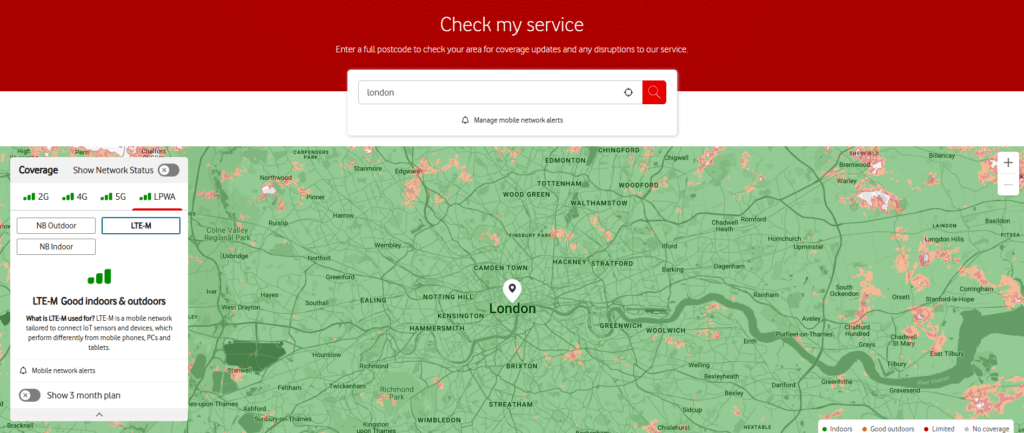
Rather than guess, you can look this up directly. Vodafone publishes a Network Coverage Checker that lets you enter a location and see signal strength specifically for NB-IoT and LTE-M — the same category of network AlterLock Gen3 uses, not just ordinary phone signal. It reports results in RSRP bands ranging from “Good” down to “No coverage,” with a couple of intermediate levels in between, so you can get a real read on your regular routes, your storage location, and anywhere else you’d want the device to keep working.
A few sensible places to check before you buy or before a specific ride:
- Wherever you normally park or store the bike (home, garage, office).
- Your typical commuting or riding routes.
- Any remote or rural area you’re planning to ride through, especially if you’re relying on tracking as a safety net.
What This Means for Your Riding
None of this makes AlterLock Gen3 less useful — it just means setting the right expectations. For city riding, commuting, and most populated areas across the UK, you’re well within the kind of coverage the device needs to report reliably. For rides deep into the countryside, forested trails, or genuinely remote terrain, treat GPS tracking as a bonus rather than a guarantee, and check the coverage checker above if you want to know before you go. As always, AlterLock works best as one layer of protection alongside sensible basics like a good physical lock — not a replacement for them.
Bottom Line
AlterLock Gen3’s tracking runs on real mobile network infrastructure, and real infrastructure has real gaps — heaviest in cities and populated areas, thinnest in remote countryside, forests, and open water. Rather than take that on faith, use Vodafone’s coverage checker to see exactly what to expect on your own routes before you rely on it.
Disclaimer: AlterLock is a device that supports theft deterrence and early detection. It does not guarantee prevention of theft. Always use physical locks in combination with AlterLock for best results. Network coverage varies by location and is outside AlterLock’s control — check coverage in your area before relying on GPS tracking in remote or rural locations.