
Why Bicycle Theft Demands Multi‑Layered Protection
Bicycle theft techniques continue to evolve year after year, and high‑value road bikes and e‑bikes are increasingly targeted. AlterLock interviewed three individuals—each in different circumstances—who experienced bike theft first‑hand. This article captures the essence and takeaways from those interviews, offering actionable ideas to help riders better protect their bikes in everyday life. These cases happened in Japan but the basis theft prevention applies to anywhere else in the world. Don’t leave unattended for too long in high risk areas. We hope that their testimonials can help you prevent future thefts.
Interview #1: Cross‑Bike Stolen in Tokyo—A “Just a Few Hours” Gap at Home
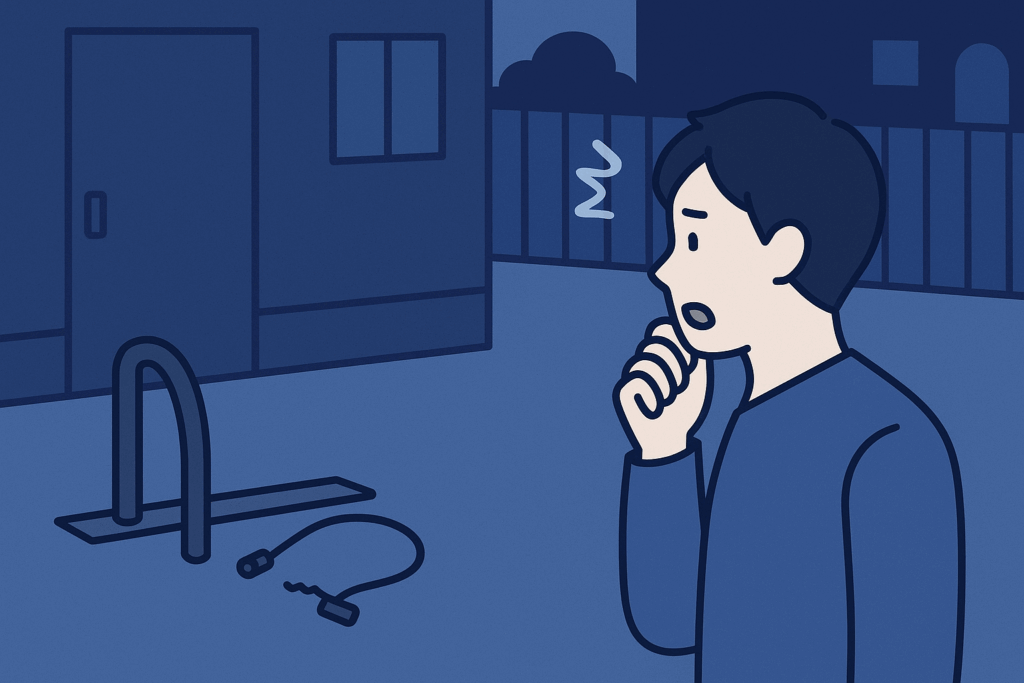
Overview
A rider (Mr.K) living in Tokyo parked a cross‑bike in front of home with a wire lock. Within a few hours, the bike was gone. The interview walks through the police report, neighborhood tips, and the protective measures Mr.K reconsidered afterward.
Reading Highlights
The reality of “home‑front theft” triggered by short lapses
Evening‑to‑night, a bike left at home for just a few hours was taken. The case reveals everyday parking risks that feel “safe” until they aren’t.
Practical protective measures Mr.K adopted afterward
Mr.K doubled down on locking to an immovable object (“frame + wheel” to a fixed anchor), added a tag/tracker and an alarm, and changed daily habits to remove “easy windows” for thieves
Interview #2: Road Bike Returned After 8 Months—What Changed and Why It Was Targeted
Overview
Mrs.F in Osaka had a road bike stolen in front of home on a day it was left un‑locked. Over the following months, it became clear the thief had scouted several times. Eight months later the bike resurfaced, and Mrs.F used the experience to overhaul protection.
Reading Highlights
The bike came back after 8 months—and the reasons it was singled out became clear
The un‑locked day and repeated pre‑theft scouting stood out as key background factors.
Countermeasures that proved effective afterward
Mrs.F switched to indoor storage where possible and combined a strong lock with an alerting device (e.g., AlterLock) to add audible deterrence and real‑time awareness.
Interview #3: Road Bike Stolen Between Midnight and 2 a.m.—It Can Happen Anywhere
Overview
Ms.K, a university student in Akita, left a road bike un‑locked around midnight to 2 a.m. in a quiet area. Within two hours, it was taken. Surprisingly, the bike returned 2–3 weeks later—and the experience led to practical changes.
Reading Highlights
The risk of “just two hours” un‑locked—especially late at night
Low foot traffic and an un‑locked bike created a simple, fast theft opportunity—even in a small city.
What Ms.K changed after getting the bike back
Ms.K set up never‑forget routines for the key, adopted AlterLock for motion alerts, and made ground‑truth changes: locking to fixed objects, choosing visible locations, and cutting “short windows” thieves exploit.

The U.S. Bike Theft Landscape: What Recent Numbers Say
To help North American readers calibrate risk and prioritize protections, here are current, citable statistics from U.S. sources.
Reported vs. Estimated Theft Volumes
- 127,646 bicycles were recorded as stolen in the U.S. in 2023 (about 3% of all larceny‑thefts in FBI data). Reporting quality has been affected because ~37% fewer law‑enforcement agencies have submitted data to the FBI since 2021.
Source: 2025 Bike Index Annual Bike Theft Report (PDF) [bicycleretailer.com] - To get closer to the true nationwide number, an academic study (UC Davis & UC Santa Barbara with Bike Index, 2024 survey; published Jan 16, 2025) estimates ~2.38 million adult bicycles stolen annually in the U.S., valued at ~$1.44 billion—far above police reports due to under‑reporting.
Source: Findings Press—Bicycle Theft in the US: Magnitude and Equity Impacts [findingspress.org]
Under‑Reporting and Data Gaps
- Under‑reporting remains significant: Bike Index’s research indicates only ~37% of theft victims file a police report, and the drop in agency reporting since 2021 further obscures national trends.
Source: 2025 Bike Index Annual Bike Theft Report (PDF) [bicycleretailer.com] - Media coverage summarizing the report echoes these gaps and the scale of ~2.4M thefts each year, with a 15% year‑over‑year rise in Bike Index registry thefts in 2024.
Sources: Bicycle Retailer—Report coverage; BikePortland—Report overview [bicycleretailer.com], [bikeportland.org] [bicycleretailer.com] [bikeportland.org]
Where Theft Happens and How It’s Changing
- The same academic work and Bike Index data show residential settings account for ~59% of thefts, with organized rings and smash‑and‑grab retailer hits rising; e‑bikes are increasingly targeted.
Source: 2025 Bike Index Annual Bike Theft Report (PDF) [bicycleretailer.com]
State‑Level Snapshot (FBI incident data, 2023)
- California recorded 21,339 stolen/lost bikes (highest absolute number), followed by Texas (12,261), Colorado (7,433), Florida (6,790), and New York (6,166). Per‑capita, Colorado stands out with a much higher rate.
Source: JOIN Cycling Tips—FBI data analysis by state (2023) [join.cc]
What these U.S. stats mean for everyday riders
Even “safe‑looking” places (home garages, apartment bike rooms) aren’t safe by default. Short time windows, late‑night gaps, and any un‑locked moments are high‑risk. Combine strong physical locking, smart alerts and registration/ID to raise deterrence and recovery odds.
Practical Countermeasures You Can Start Today
Layer 1 — Physical Security (Make Removal Slow and Noisy)
- Always lock the frame and a wheel to a fixed, immovable object (bike rack bolted to ground, ground anchor, or a robust structure). Prefer two different lock types (e.g., a U‑lock + heavy chain).
- Avoid cable‑only locks for primary security; cables are quickly defeated.
Layer 2 — Place & Routine (Remove Thief Windows)
- Indoors beats outdoors when feasible. If outside, choose visible, surveilled, well‑lit spots.
- Eliminate “forgot‑the‑key” and “just a few hours” lapses with checklists or habits (key on same carabiner; alarms auto‑armed; quick lock routine on every stop).
Layer 3 — Awareness & Alerts (React Fast)
- Motion‑sensing alarms and connected devices (e.g., AlterLock) can sound, notify, and escalate in seconds—crucial during short‑window theft attempts.
- Where legal, tags/trackers can help post‑incident recovery and police coordination.
Layer 4 — Identity & Recovery (Prepare Before It’s Needed)
- Register your bike (serial number, photos, components). Registration improves recovery odds by making fencing harder and identification easier; communities using Bike Index show material improvements in recoveries.
Source: 2025 Bike Index Annual Bike Theft Report (PDF) [bicycleretailer.com]
Summary: Three Lessons to Protect Your Ride
- One tactic isn’t enough
A single lock or GPS alone can be defeated; stack layers: strong physical lock(s) + alerts + registration. Opportunistic thieves target easy, visible bikes. - Theft happens in “short, bright, safe‑looking” windows
Daylight or well‑lit areas do not guarantee safety. Scouting is common; un‑locked moments are taken. - After‑the‑fact is costly—time, money, stress
Filing reports, searching, and repurchasing take weeks or months; recovery odds improve only when you prepared beforehand (ID, registration, alerts, lock discipline).
Sources & Further Reading (U.S. Data)
- 2025 Bike Index Annual Bike Theft Report (PDF) — FBI larceny‑theft share (3%), 2023 count (127,646), under‑reporting and agency participation drop, residential share, and recovery case studies. [bicycleretailer.com]
- Findings Press (Jan 16, 2025): Bicycle Theft in the US: Magnitude and Equity Impacts — Academic estimate of ~2.38M bikes stolen annually, ~$1.44B value; methodology and equity impacts. [findingspress.org]
- Bicycle Retailer (Jan 29, 2025): Bike Index 2025 report coverage — Registry thefts up 15% YoY; context and highlights. [bicycleretailer.com]
- JOIN—FBI data analyzed by U.S. state (2023) — State counts, value estimates, and per‑capita comparisons (e.g., CA, TX, CO, FL, NY). [join.cc]
- FBI Uniform Crime Reporting—Larceny‑Theft (definition & context) — Offense definition that includes bicycle theft. [ucr.fbi.gov]